
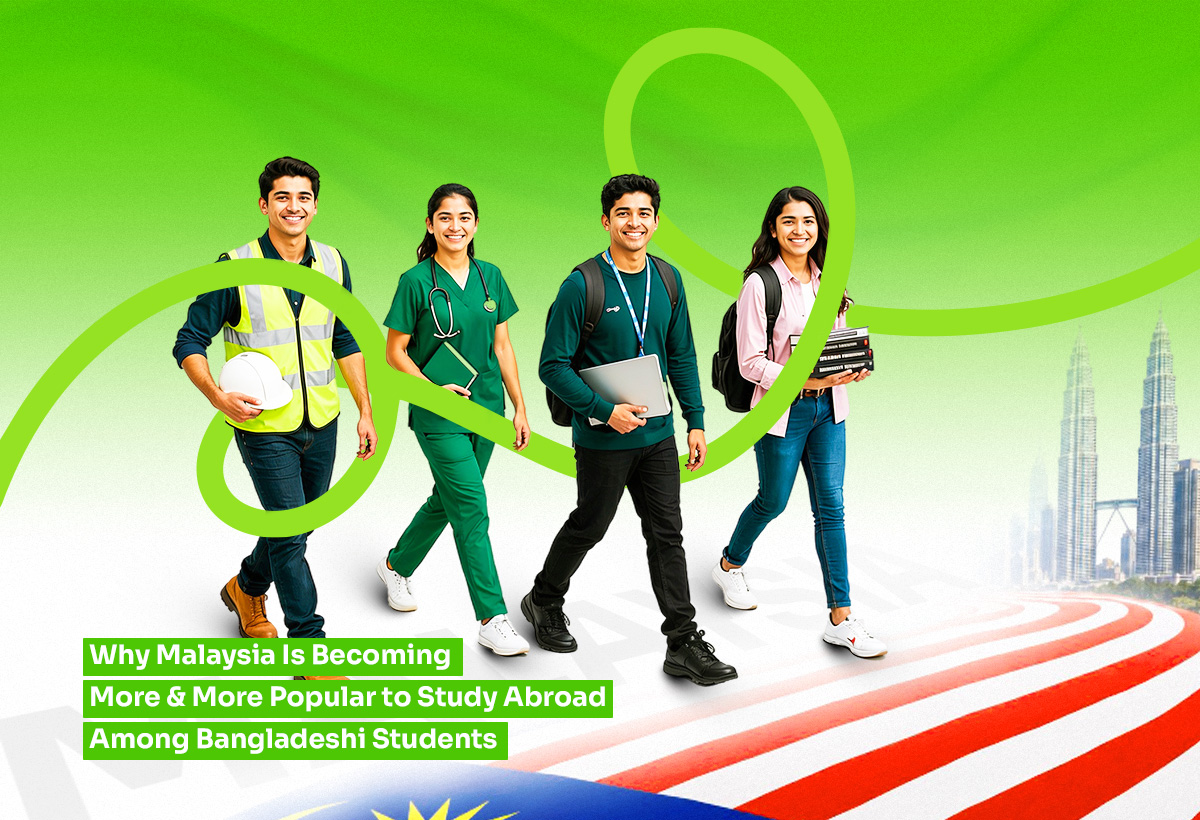
A few years ago, if a student
told their parents "I want to study abroad," the conversation almost
always ended up in one of three places: the UK, Australia, or Canada. Ask the
same question today, and there's a good chance Malaysia comes up too, and not
as a backup plan, but as the first choice.
That shift isn't random. Malaysia
has quietly built an education system that ticks boxes most families care about
most: recognized degrees, a manageable budget, and a much easier road to get
there. We work with students planning to study in Malaysia from Bangladesh
every day at Education Hub, and honestly, the number of "why didn't I know
about this sooner" reactions we get says a lot.
So let's break down what's
actually driving this trend — and what you need to know if you're considering
Malaysia for yourself.
1. The Education Quality Genuinely Holds Up
This is usually the first worry:
"Is a Malaysian degree actually worth it?" Fair question. The answer
is yes, and here's why.
A lot of Malaysian universities
aren't just local institutions — they're branch campuses or twinning partners
of well-known UK and Australian universities, running the same syllabus, the
same assessment standards, and often the same faculty training. Degrees are
regulated by the Malaysian Qualifications Agency (MQA), which keeps quality in
check across the board. Employers and universities abroad recognise Malaysian
qualifications without a second glance.
In short: you're not settling for less. You're paying less for something that holds the same weight.
2. Dual Degree Options
Study in Two Countries, Pay for Mostly One Here's the part that surprises most parents. Many Malaysian universities run 1+2 or 2+1 dual degree arrangements — spend the first year (or two) in Malaysia, then transfer to the UK, Australia, or another partner country to finish the degree.
What that means in practice:
- You graduate with a degree recognized
by two institutions, one in Malaysia another from UK/Asutralia
- Your most expensive years
abroad get replaced by cheaper years in Malaysia
- You still get the "final year abroad" experience, just without the full four-year price tag
Since Education Hub is an authorized partner for a number of these universities, we can tell you exactly which dual degree routes exist for the programme you're eyeing and route your application directly to the university.
3. You Can Apply Right After O Level or A Level
This one catches a lot of
students off guard. In many other countries, you're stuck waiting to complete
your HSC/A Level before anything moves forward. In Malaysia, that's often not
the case.
- Foundation and pathway
programmes accept students straight after O Level
- Undergraduate degree programmes
accept students after A Level
That's a real head start! Less sitting around, faster entry into a bachelor's programme, and a year or more saved compared to the usual route.
4. No IELTS? Not a Dealbreaker
IELTS is expensive,
time-consuming, and honestly, not something every strong student wants to deal
with. Malaysia doesn't force the issue. Depending on the university, you can
get in through
- English-medium O/A Level or HSC
results as proof of English proficiency
- MUET or similar alternative
assessments
- An internal English test set by
the university itself
If you've studied in
English-medium school your whole life, this alone can save you months of prep
and a fair amount of money.
5. Admission Process &
What It Actually Costs
Students always expect this part
to be complicated. It isn't, if you know the steps:
1. Shortlist a
university and programme that matches your results and goals
2. Submit your
application with transcripts and certificates
3. Get your
offer letter from the university
4. Apply for
your Student Pass through Education Malaysia Global Services (EMGS)
5. Pay tuition,
sort accommodation, and prepare for visa stamping and departure
Roughly, here's what it costs:
- Tuition: Typically, 40–60%
lower than a comparable UK or Australian degree
- EMGS Student Pass fee: A one-time
government processing charge
- Living costs: Noticeably lower
than Western study destinations, covering rent, food, and transport
Start to finish, this usually
takes 2–4 months, so the earlier you start, the more intake options and
university choices stay open.
This is exactly where things tend
to go wrong for students applying on their own — a missing document, a wrong
intake date, a delay nobody warned them about. Applying through Education Hub
means our team handles the offer letter, EMGS paperwork, and documentation
directly with the universities, so those delays don't happen to you.
6. What Bangladeshi Students Are Actually Studying
If you're wondering what's
popular, here's where most students are landing:
- Business
Administration & Management
- Computer
Science & Information Technology
- Engineering
(Civil, Mechanical, Electrical, Petroleum)
- Hospitality
& Tourism Management
- Medicine,
Pharmacy & Health Sciences
- Accounting & Finance
It's not just about job demand, either these are the fields where Malaysian universities have the strongest
industry ties, internship pipelines, and (again) dual degree routes into the
same subject abroad.
So, Is Malaysia Right for You?
If a recognized degree, a faster
start after O/A Level, no forced IELTS, and a budget your family can actually
manage without stress all matter to you, Malaysia is worth taking seriously,
not just as a backup option. The exact university, programme, and pathway that
fits you still comes down to your own results and goals, and that's the
conversation worth having with a counsellor before you apply anywhere.
As an authorized partner for
Malaysia's leading universities, Education Hub can match you with the right
programme, confirm your eligibility, and manage your entire application from
start to finish, so you're not figuring this out alone.
Thinking seriously about studying
in Malaysia? Apply through Education Hub and let our counsellors handle the
details while you focus on getting ready.
Frequently Asked Questions
Q: Can I study
in Malaysia right after O Level or A Level?
A: Yes.
Foundation and pathway programmes accept students after O Level, and
undergraduate degrees accept students after A Level.
Q: Do I need
IELTS to study in Malaysia?
A: Not always.
Many universities accept English-medium academic results or their own internal
English test instead of IELTS.
Q: Are Malaysian degrees
recognised in the UK or Australia?
A: Yes. Degrees regulated by the
Malaysian Qualifications Agency (MQA) are widely recognised, and many
programmes offer direct credit transfer through dual degree arrangements.
Q: How long does the Malaysian
student visa (EMGS) process take?
A: The full admission-to-visa
process typically takes 2–4 months.
Q: How can Education Hub help
with my Malaysia application?
A: As an authorized partner for
top Malaysian universities, Education Hub manages your entire application,
from choosing the right programme to offer letter, EMGS Student Pass, and
documentation.
Read Time: 13 min | Total Reads: 72 | Published: 22 Jul, 2026